Risky Play: The Parenting Habit That Builds Confidence, Not Chaos
I shared a post on socials this week after a morning out with my youngest son, Conlan. We were walking in the forest when we came across a large fallen tree. I didn’t intervene. I didn’t coach. I didn’t pre-empt the danger. I simply stepped back and let him lead
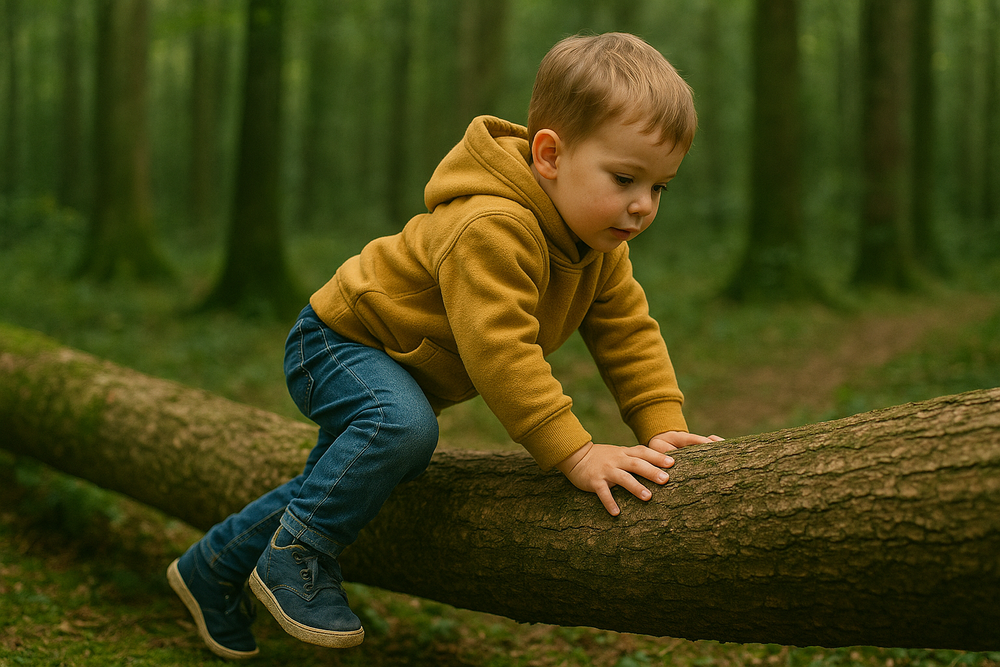
He marched straight over, put his hands on the trunk, lifted his little leg to try and climb it — and slipped, landing on the mossy ground. I didn’t run over with panic. I just said, “Well done — up we get.” He stood up, brushed himself off, and with perfect toddler timing looked at me and said, “Daddy… ice cream.”
There were a few things I took from that simple moment, but one in particular stands out: the environment I created by stepping back. I gave space for risky play — the kind that involves uncertainty, challenge, and decision-making — and let him solve a problem without rescue.
What is “risky play” and why does it matter?
Risky play doesn’t mean danger or negligence — it means age-appropriate challenges that push a child slightly beyond what is easy or guaranteed. Climbing, balancing, exploring uneven ground, rough-and-tumble play, handling real tools under supervision — these all sit under risky play.
A growing body of research shows clear benefits:
- Mariana Brussoni (University of British Columbia) found that outdoor risky play “promotes resilience, social competence, creativity and problem-solving.”
- Ellen Sandseter’s work (Norwegian University of Science and Technology) shows that children who engage in risky play develop better risk assessment skills — meaning they become safer, not less.
- The American Academy of Pediatrics has written that over-protective environments can limit motor development and emotional confidence.
In other words: shielding children from all risk doesn’t keep them safe — it just keeps them unpractised.
What children learn when we step back
From that one tree, Conlan practiced:
- Risk judgement — “Can I do this?”
- Motor planning — how to position body, hands, feet
- Emotional regulation — falling without meltdown
- Resilience — getting back up and trying again
- Autonomy — doing something without adult instruction
All because I didn’t step in.
How parents can add more “safe risk” into daily life
You don’t need forests or fallen trees. You just need space and permission.
At home
- Let them climb onto the sofa or low walls without lifting them
- Allow blanket forts, cushions, and rough-and-tumble play
- Offer simple tools: butter knife for banana, real jug of water to pour
Outdoors
- Walk on logs, rocks, uneven hills instead of flat paths
- Let them balance on boulders or hang from branches
- Stop warning “be careful” — try “you’ve got this” or “how will you do it?”
In your language
- Replace panic with presence
- Replace instructions with curiosity (“What’s your plan?”)
- Replace rescue with encouragement (“Try again if you want to.”)
The real risk is removing all risk
Children who never get to test themselves don’t just miss out on physical skills.
They miss the feeling of I can figure this out myself.
That morning in the forest was nothing dramatic — just a boy, a tree, a fall, and an ice cream request. But inside it was a lesson in confidence, competence, and controlled risk.
Sometimes the most powerful thing we can do is take one big step back and let them climb.